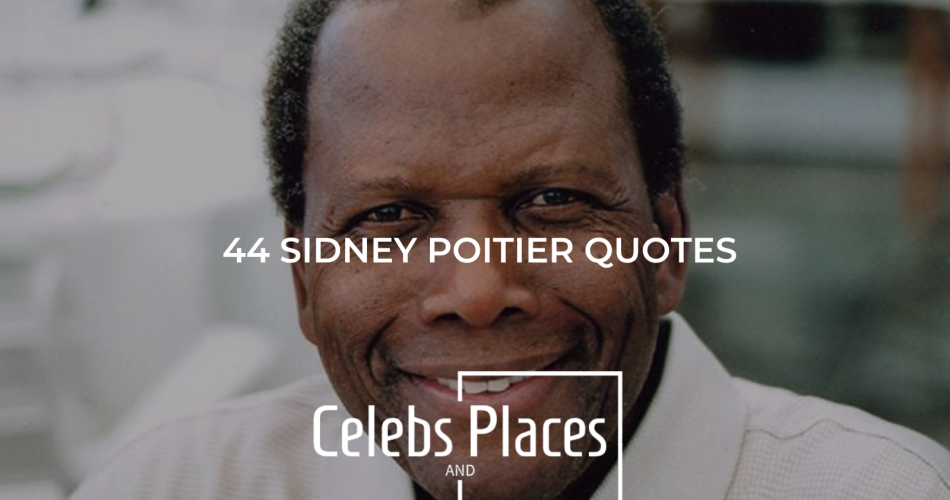
Sidney Poitier was more than just a legendary actor—he was a trailblazer, a philosopher of life, and an unwavering advocate for dignity and self-improvement. Through his words, he imparted profound wisdom on topics such as resilience, love, integrity, and personal growth. His reflections on fear, responsibility, and the pursuit of excellence continue to inspire generations. In this collection, we explore some of the most powerful Sidney Poitier quotes on life, love, personal growth, success, and integrity.
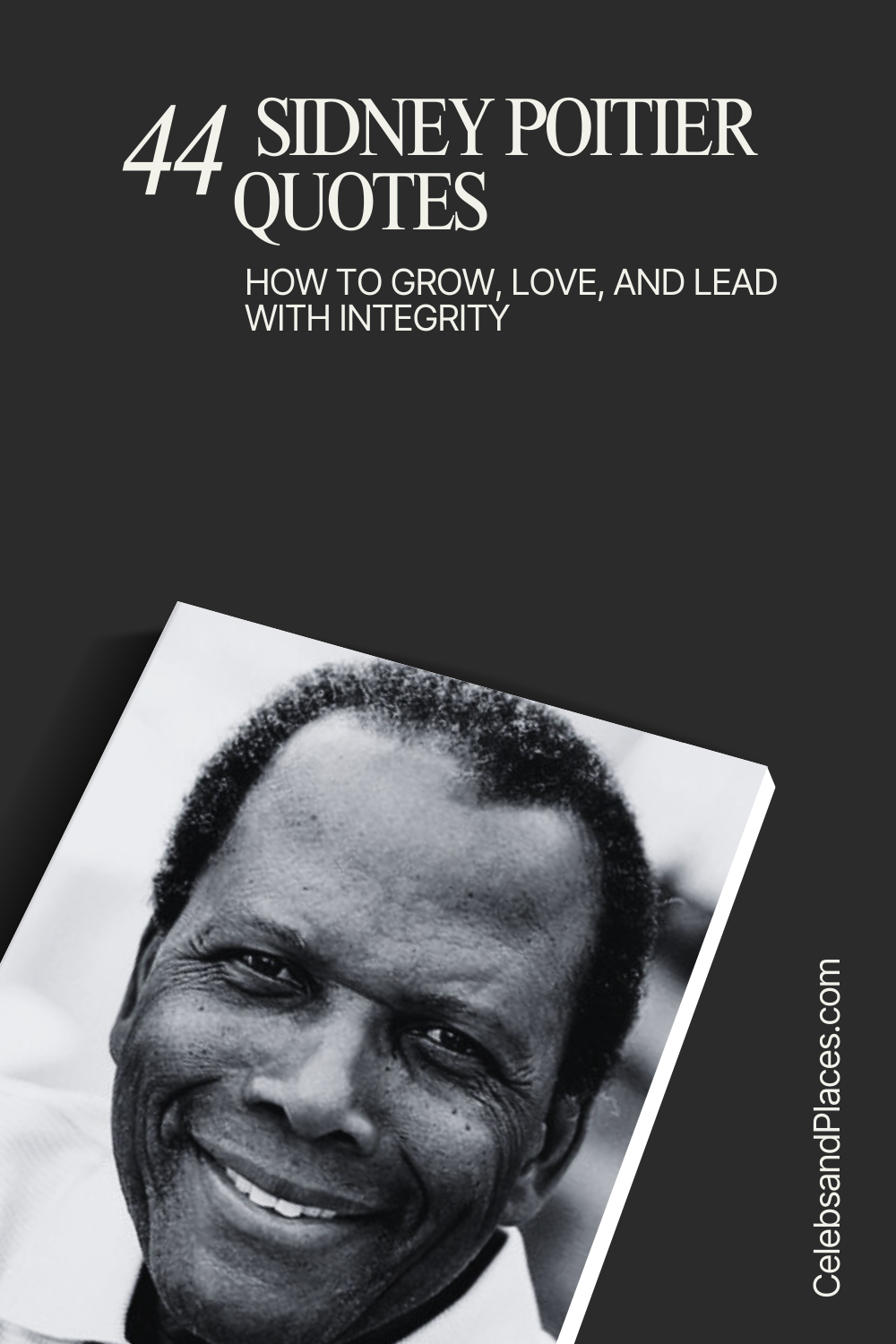
Inspiring Sidney Poitier Quotes
Sidney Poitier’s words emphasize self-determination, resilience, and the necessity of personal responsibility. His statement, “I am the me I choose to be,” underscores the idea that identity is not something passively inherited but actively constructed. This theme aligns with his assertion that improvement does not necessitate changing one’s essence, reinforcing the belief that growth and self-betterment come from refining, not discarding, one’s core values. Poitier acknowledges the power of choice in shaping one’s destiny and highlights the importance of integrity and self-definition rather than conforming to societal pressures or external expectations. His reflections encourage individuals to embrace self-ownership and continuous growth without compromising authenticity.
Beyond personal development, Poitier discusses the role of family and social values in shaping character. He argues that modern society, with its excessive indulgence and detachment from responsibility, risks making individuals disconnected from the fundamental bonds that sustain communities. By emphasizing that children need to contribute and take responsibility within their families, he highlights the significance of discipline, interdependence, and shared purpose. This perspective critiques modern parenting and societal structures that shelter individuals from real-world struggles, advocating for an upbringing rooted in responsibility and communal values. His words suggest that a lack of struggle may hinder personal development and that genuine fulfillment comes from meaningful participation in one’s family and society.
Poitier also confronts issues of injustice, power dynamics, and the necessity of channeling anger into constructive action. He acknowledges that the world is unjust and that anger, if left unchecked, can become destructive. Instead, he advocates for channeling rage into forgiveness and positive transformation. This philosophy extends to broader societal struggles, where he critiques power structures that resist accountability and perpetuate systemic inequalities. His words serve as a call to action, urging individuals not to succumb to bitterness but to seek ways to challenge oppression while maintaining their moral integrity. By linking personal growth with societal change, Poitier presents a vision in which self-improvement and social justice go hand in hand, reinforcing the idea that individuals who cultivate strength and wisdom within themselves are better equipped to confront and reshape the world around them.
- “I am the me I choose to be.” – Sidney Poitier
- “A person doesn’t have to change who he is to become better.” – Sidney Poitier
- “I don’t mean to be like some old guy from the olden days who says, ‘I walked thirty miles to school every morning, so you kids should too.’ That’s a statement born of envy and resentment. What I’m saying is something quite different. What I’m saying is that by having very little, I had it good. Children need a sense of pulling their own weight, of contributing to the family in some way, and some sense of the family’s interdependence. They take pride in knowing that they’re contributing. They learn responsibility and discipline through meaningful work. The values developed within a family that operates on those principles then extend to the society at large. By not being quite so indulged and ‘protected’ from reality by overflowing abundance, children see the bonds that connect them to others.” – Sidney Poitier
- “I’ve learned that I must find positive outlets for anger or it will destroy me. There is a certain anger: it reaches such intensity that to express it fully would require homicidal rage–self destructive, destroy the world rage–and its flame burns because the world is so unjust. I have to try to find a way to channel that anger to the positive, and the highest positive is forgiveness.” – Sidney Poitier
- “Okay listen, you think I’m so inconsequential? Then try this on for size. All those who see unworthiness when they look at me and are given thereby to denying me value – to you I say, I’m not talking about being AS GOOD as you. I hereby declare myself BETTER than you.” – Sidney Poitier
- “Forgiveness works two ways, in most instances. People have to forgive themselves too. The powerful have to forgive themselves for their behavior. That should be a sacred process.” – Sidney Poitier
- “Child psychologists have demonstrated that our minds are actually constructed by these thousands of tiny interactions during the first few years of life. We aren’t just what we’re taught. It’s what we experience during those early years – a smile here, a jarring sound there – that creates the pathways and connections of the brain. We put our kids to fifteen years of quick-cut advertising, passive television watching, and sadistic video games, and we expect to see emerge a new generation of calm, compassionate, and engaged human beings?” – Sidney Poitier
- “You don’t have to become something you’re not to be better than you were.” – Sidney Poitier
- “As I entered this world, I would leave behind the nurturing of my family and my home, but in another sense I would take their protection with me. The lessons I had learned, the feelings of groundedness and belonging that have been woven into my character there, would be my companions on the journey.” – Sidney Poitier
- “We’re all somewhat courageous, and we’re all considerably cowardly. We’re all imperfect, and life is simply a perpetual, unending struggle against those imperfections.” – Sidney Poitier
- “So much of life, it seems, is determined by pure randomness.” – Sidney Poitier
- “Accept that environment compromises values far more than values do their number on environment.” – Sidney Poitier
- “As I’ve mentioned, a large part of my father’s legacy is the lesson he taught his sons. He brought us together and said, ‘The measure of a man is how well he provides for his children.” – Sidney Poitier
- “Acting isn’t a game of ‘pretend.’ It’s an exercise in being real.” – Sidney Poitier
- “Of all my father’s teachings, the most enduring was the one about the true measure of a man. That true measure was how well he provided for his children, and it stuck with me as if it were etched in my brain.” – Sidney Poitier
- “But perhaps more important, as someone wishing to make a comment or two about contemporary life and values, I don’t have to dig through libraries or travel to exotic lands to arrive at a view of our modern situation refracted through the lens of the preindustrial world, or the uncommercialized, unfranchised, perhaps unsanitized-and therefore supposedly more ‘authentic’-perspective of the Third World. Very simply, this is because that “other” world, as alien as if separated by centuries in time, is the one from which I came” – Sidney Poitier
- “If the image one holds of one’s self contains elements that don’t square with reality, one is best advised to let go of them, however difficult that may be.” – Sidney Poitier
- “Greed and cruelty are pretty widely distributed throughout humanity, as are their victims.” – Sidney Poitier
- “We put our kids to fifteen years of quick-cut advertising, passive television watching, and sadistic video games, and we expect to see emerge a new generation of calm, compassionate, and engaged human beings?” – Sidney Poitier
- “We fight good wars in medical laboratories, endlessly seeking to cure the scourges of cancer, heart disease, diabetes, and mental illness. We fight good wars when we devote time, energy, and money to relieve the suffering of hungry people around the world. We fight good wars when we come to the aid of those struck by the overwhelming forces of capricious nature: fire, flood, drought, hurricanes, and earthquakes. We fight good wars when we refuse to allow injustice to be done to others. We fight good wars when we oppose hate, bigotry, and ignorance. These” – Sidney Poitier
- “When you’re addressing power, don’t expect it to crumble willingly. If you’re going to say, ‘Hey now, look you guys, please look at what you did and look at yourselves and punish yourselves and at least try to square this thing, right?’—well, you’ll make slower progress at that than you would expect. I mean, even the most modest expectations are going to be unfulfilled. Think about it. Today there are still people all over the world who maintain that the Holocaust didn’t happen. There are people in the United States—people among that power echelon we speak of—who maintain that all slaves were happy. There are those power symbols that always say, ‘Well, it was for the good of the states. It was for the cohesion of the political process.’ There are myriad justifications for denial. There are also people who say, ‘Hey, after thirty years of affirmative action, they’ve got it made. Black people—it’s their own fault if they can’t make it today.’ Yeah, well, of course they say that. And they say it not just about black people. They say it in every country. We did something for you people, whoever ‘you’ are. And we think that’s quite enough now. That’s the gist of it: we’ve done something, and we think it’s enough. It may not be perfect, but it damn sure comes close to being okay. Now let us hear you applaud that for a little while. And thank us. And you can take that hat off your head when you come in here thanking us. That’s the way it is. But let’s not get stuck there. We have miles to go before we sleep. We have lots to do, and some things just aren’t going to get done, you know?” – Sidney Poitier
More Famous Quotes by Sidney Poitier
Sidney Poitier’s words reflect a deep commitment to self-improvement, integrity, and human connection. His thoughts on receiving help highlight the unpredictable nature of life and the importance of humility in accepting assistance, recognizing that our journeys are often shaped by external forces as much as internal will. Similarly, his reflections on love within marriage emphasize the significance of expressing affection daily, reinforcing the idea that relationships require conscious effort and acknowledgment to thrive. His view on loss reveals a profound understanding of human interconnectedness, illustrating how our identities are shaped by those we cherish, and how each farewell leaves a lasting imprint on the soul.
Poitier’s wisdom extends to artistic integrity and personal responsibility. His caution against artistic favors underscores the need for creative spaces free from compromise, preserving authenticity in one’s craft. He also stresses the necessity of confronting one’s mistakes, urging self-reflection and courage in moments of moral reckoning. His definition of fear as both real and perceived serves as a reminder that courage is not the absence of fear but the willingness to face it. His philosophical observation that “we are what we are, and half of what we are is what we are not” suggests that our identities are shaped as much by our limitations as by our aspirations.
Above all, Poitier’s reflections encapsulate a lifelong dedication to conscious living and personal evolution. He believes in walking in step with others, embracing authenticity, and setting high personal standards to foster growth. His thoughts on race reflect a powerful stance on self-perception and dignity, while his commitment to self-betterment underscores the belief that striving for excellence is a continuous process. Poitier’s legacy is one of resilience, moral clarity, and a relentless pursuit of becoming a better person each day—an ethos that extends beyond personal success to positively impact others.
- “The willingness to receive help and appreciate its value when it arrives, sometimes unannounced, is a subject that returns us to the question of why and how our lives turn out as they do.” – Sidney Poitier
- “But there is one key ingredient that my wife has helped me to recognize over the years, and that is the importance of articulating love for one another on a daily basis. The words I love you, spoken in acknowledgment in the morning upon rising and before going to bed, or when sitting down to dine, make the most beautiful music recognized by human ears.” – Sidney Poitier
- “A tiny bit of myself is lost when my friends are gone. A tiny bit of myself was lost when my brothers, all but one, passed away.” – Sidney Poitier
- “John Cassavetes once gave me some advice that has proved invaluable… He said, ‘We’re good friends, but never, ever do an artistic favor for a friend. Loan friends money, be there for them in every other way, but don’t do them any artistic favors, because you’ve got to have one area of your life where there’s no room for compromise.” – Sidney Poitier
- “I’m telling you this so that if you ever are in the position of carrying a secret about something that you have done that makes you ashamed you will make the choice to confront yourself. It will take guts to admit that you have behaved in a way that prevents you from being your better self, and then choose to act differently. It” – Sidney Poitier
- “fear is a visceral response to imminent jeopardy, real or perceived, threatening to come crashing down on you with devastating results. Undoubtedly” – Sidney Poitier
- “We are what we are, and half of what we are is what we are not.” – Sidney Poitier
- “Living consciously involves being genuine; it involves listening and responding to others honestly and openly; it involves being in the moment” – Sidney Poitier
- “When you walk with someone, something unspoken happens. Either you match their pace or they match yours” – Sidney Poitier
- “I never had an occasion to question color, therefore, I only saw myself as what I was… a human being” – Sidney Poitier
- “I set my star so high that I would constantly be in motion toward it” – Sidney Poitier
- “We’re all imperfect, and life is simply a perpetual, unending struggle against those imperfections” – Sidney Poitier
- “To simply wake up every morning a better person than when I went to bed” – Sidney Poitier
- “I do know that I’m responsible not for what happens, but for what I make of it” – Sidney Poitier
- “You don’t have to become something that you aren’t to become better than you are” – Sidney Poitier
- “I always wanted to be someone better the next day than I was the day before” – Sidney Poitier
- “I was the only Black person on the set. It was unusual for me to be in a circumstance in which every move I made was tantamount to representation of 18 million people” – Sidney Poitier
- “If you apologize because you are afraid, then you are a child not a man” – Sidney Poitier
- “Marriage is no way of life for the weak, the selfish, or the insecure.” – Sidney Poitier
- “If I’m remembered for having done a few good things and if my presence here has sparked some good energies, that’s plenty” – Sidney Poitier
- “I defend myself by improving myself” – Sidney Poitier
- “I think the way I want to think. I live the way I want to live” – Sidney Poitier
- “I decided in my life that I would do nothing that did not reflect positively on my father’s life” – Sidney Poitier
- “I have always been a learner because I knew nothing.”— Sidney Poitier
Who Was Sidney Poitier?
Sidney Poitier was a groundbreaking actor, director, and activist who transformed Hollywood and society with his immense talent and moral conviction. Born in 1927 in the Bahamas, he overcame racial barriers to become the first Black actor to win an Academy Award for Best Actor in 1964. His performances in films like Guess Who’s Coming to Dinner, Lilies of the Field, and To Sir, with Love challenged stereotypes and reshaped how Black actors were perceived on screen.
Beyond his acting career, Poitier was a fierce advocate for civil rights and equality. He used his platform to push for social change, refusing roles that demeaned African Americans and instead choosing characters that embodied strength, intelligence, and dignity. His impact extended beyond Hollywood, as he worked closely with leaders such as Martin Luther King Jr. to fight for justice and racial equality during the Civil Rights Movement.
Poitier’s legacy is not just one of artistic achievement but of personal integrity and relentless self-improvement. He believed in setting high standards, taking responsibility for one’s actions, and living with purpose. His wisdom, drawn from both triumphs and struggles, serves as a guiding light for anyone seeking to become a better version of themselves.
Final Thoughts
Sidney Poitier’s words remind us that true success is not just about fame or fortune but about character, resilience, and the way we treat others. His insights encourage us to embrace authenticity, face challenges with courage, and continuously strive for growth. Whether in our personal lives or professional endeavors, his legacy teaches us that integrity, love, and self-improvement are the keys to a meaningful and impactful life.