Althea Gibson was more than an athlete—she was a pioneer who broke racial barriers in the world of sports during a time when segregation and discrimination were still deeply rooted in American society. As the first African American to win a Grand Slam title, her courage and determination inspired generations of athletes to dream bigger and push past limitations. Through her words and actions, Gibson left a legacy not just in tennis and golf but in the broader fight for equality, representation, and excellence. The following Althea Gibson quotes capture her spirit, strength, and timeless influence.

Althea Gibson Quotes That Prove True Champions Never Settle
Althea was a fierce competitor who understood that greatness isn’t just about reaching the top—it’s about staying there. She believed true champions are forged through consistency and hard work, not one-time victories. For her, excellence wasn’t measured by fleeting recognition but by the ability to defend, sustain, and evolve. She saw athletic success not as an accident but as the result of relentless dedication, personal sacrifice, and the will to endure. Althea knew firsthand how demanding it was to maintain elite status and how often people underestimate the labor behind the glory. Her reflections on competition reveal a deep respect for the craft and a refusal to settle for anything less than mastery.
At the heart of Althea’s journey was a powerful sense of self-worth and purpose. She knew her talent came from something greater than herself, and she didn’t need external validation to feel confident. Yet she was also keenly aware of the societal barriers she had to overcome and how surreal it was to rise from segregation to international acclaim. Her life was a testament to dual realities—being celebrated on the world stage while still confronting deep-rooted discrimination at home. And through all this, she remained grounded, recognizing that every step forward was made possible not just by personal will but by the support and belief of others. Gratitude and humility were woven into her sense of triumph.
Althea also saw the broader picture: that success, especially for a Black woman in mid-20th-century America, was more than trophies or titles. She sought fairness, opportunity, and backing—the kind often afforded to others without question. She reminded the world that being a champion doesn’t pay the bills and that athletes, no matter how accomplished, still need tangible support. She believed in earning her place, but also in claiming what was rightfully due. Her legacy isn’t just about records broken or barriers shattered—it’s about the courage to demand better, the honesty to acknowledge the help along the way, and the grace to inspire others to rise just as she did.
- “In sports, you simply aren’t considered a real champion until you have defended your title successfully. Winning it once can be a fluke; winning it twice proves you are the best.” – Althea Gibson
- “In the field of sports you are more or less accepted for what you do rather than what you are.” – Althea Gibson
- “Most of us who aspire to be tops in our fields don’t really consider the amount of work required to stay tops.” – Althea Gibson
- “Shaking hands with the Queen of England was a long way from being forced to sit in the colored section of the bus going into downtown Wilmington, North Carolina.” – Althea Gibson
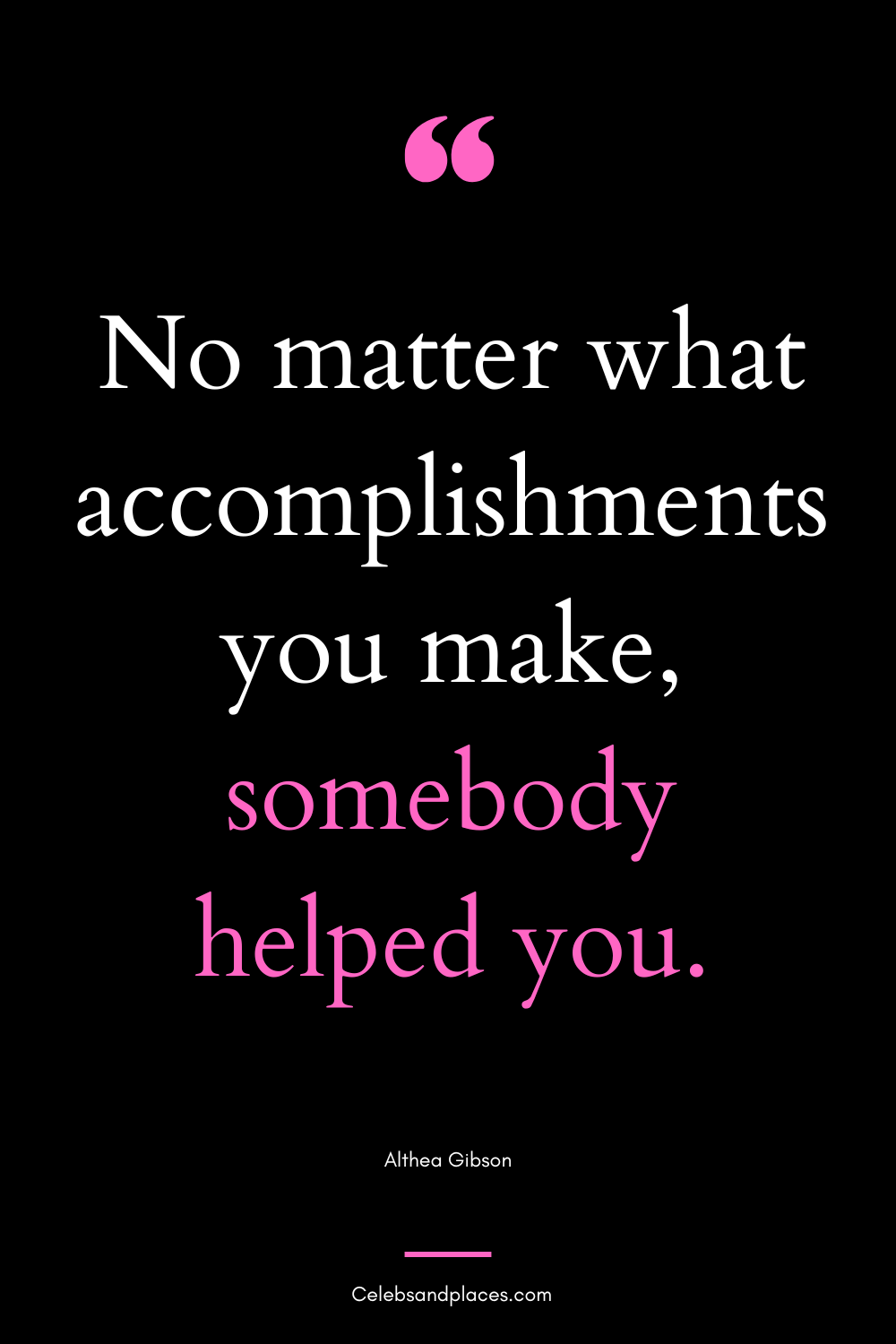
- “No matter what accomplishments you make, somebody helped you.” – Althea Gibson

- “I knew that I was an unusual, talented girl through the grace of God. I didn’t need to prove that to myself. I only wanted to prove it to my opponents.” – Althea Gibson
- “I always wanted to be somebody. If I made it, it’s half because I was game enough to take a lot of punishment along the way and half because there were a lot of people who cared enough to help me.” – Althea Gibson
- “Being champion is all well and good, but you can’t eat a crown.” – Althea Gibson
- “I don’t consciously beat the drums for any cause—not even for Negroes in the United States.” – Althea Gibson
- “I think I have done enough for sports and made enough of a name for myself to deserve some sort of backing – most of the other girls have it.” – Althea Gibson
You may also like: 38 Inspirational Wilma Rudolph Quotes on Perseverance, Dreams, and Triumph

More Famous quotes by Althea Gibson
Althea was a fierce believer in the mindset that separates winners from spectators. Her approach to life and sports was deeply rooted in personal accountability, resilience, and mental grit. She understood that excuses were the language of defeat, while solutions were the path to greatness. For Althea, winning wasn’t just about trophies—it was about owning your path, believing in what was possible even in the face of obstacles, and showing up prepared to do the work. Her journey from humble beginnings to the global spotlight reflected this unshakable determination to prove what could be done, no matter how difficult the route.
Beyond the courts, Althea never forgot the people who lifted her up along the way. She often reflected on the importance of support—acknowledging that greatness is rarely a solo achievement. At the same time, she carried herself with fierce independence and competitive fire. She didn’t just want to be seen—she wanted to be known, respected, and remembered for what she did, not what she represented. That desire gave her a relentless drive to win, and the emotional honesty to admit when she was nervous or uncertain. But make no mistake—when the match began, Althea played to dominate.
Even with fame and accolades, Althea remained grounded. She never wanted to be idealized or turned into a symbol. She simply wanted to be successful, live a decent life, and be known for her identity and excellence. That clarity of purpose was her compass, guiding her through the noise of politics, pressure, and expectation. Her story reminds us that purpose is a powerful fuel—and with it, the impossible becomes possible, even when you’re starting from a place like 143rd Street in Harlem and setting your sights on Wimbledon’s center court.
- “The loser is always a part of the problem; the winner is always a part of the answer. The loser always has an excuse; the winner always has a program. The loser says it may be possible, but it’s difficult; the winner says it may be difficult, but it’s possible.” – Althea Gibson
- “I want the public to remember me as they knew me: athletic, smart, and healthy… Remember me strong and tough and quick, fleet of foot and tenacious.” – Althea Gibson
- “People thought I was ruthless, which I was. I didn’t give a darn who was on the other side of the net. I’d knock you down if you got in my way.” – Althea Gibson
- “I hope that I have accomplished just one thing: that I have been a credit to tennis and my country.” – Althea Gibson

- “I was nervous and confident at the same, nervous about going out there in front of all those people, with so much at stake, and confident that I was going to go out there and win.” – Althea Gibson
- “From 143rd Street in Harlem to the center court at Wimbledon is about as far as one can travel.” – Althea Gibson
- “I don’t want to be put on a pedestal. I just want to be reasonably successful and live a normal life with all the conveniences to make it so. I think I’ve already got the main thing I’ve always wanted, which is to be somebody, to have identity. I’m Althea Gibson, the tennis champion. I hope it makes me happy.” – Althea Gibson
- “If you have a purpose in which you can believe, there’s no end to the amount of things you can accomplish.” – Althea Gibson
Who Was Althea Gibson?
Althea Gibson was born on August 25, 1927, in Silver, South Carolina, and grew up in Harlem, New York City. Raised in a working-class family during the Great Depression, she discovered her love for sports early on. Initially drawn to paddle tennis on the streets of Harlem, she eventually transitioned into amateur tennis, quickly catching the attention of prominent coaches who recognized her raw talent and athleticism. Despite the racial barriers that limited access to top-level training and competition, Gibson’s persistence propelled her into the national spotlight.
In the 1950s, Gibson made history by becoming the first African American athlete to compete in—and win—prestigious tennis tournaments such as the French Open, Wimbledon, and the U.S. Nationals. Her Wimbledon victory in 1957 was not just a personal triumph; it was a historic moment that challenged the norms of a segregated sport and society. At a time when African Americans were systematically excluded from many public institutions, Gibson’s success was a beacon of progress and representation. She won a total of 11 Grand Slam titles, both in singles and doubles, during her tennis career.
Not content with conquering one sport, Althea Gibson later broke new ground in professional golf. In 1964, she became the first Black woman to join the Ladies Professional Golf Association (LPGA) tour. Her transition into golf came with fresh challenges, as racism and exclusion were still rampant. Nonetheless, she persevered, opening doors for Black athletes across all sports. Off the court and green, she was also an advocate for education and civil rights, using her platform to encourage young people to strive for greatness. Althea Gibson died in 2003, but her legacy remains a powerful testament to what it means to lead with courage, resilience, and purpose.
Final Thoughts
Althea Gibson’s legacy extends far beyond her groundbreaking achievements in tennis. She was a trailblazer who defied societal expectations, broke racial barriers, and left an indelible mark on the world of sports. Althea’s journey from Harlem to Wimbledon is a testament to her resilience, unwavering belief in herself, and relentless pursuit of excellence. Her words continue to inspire, emphasizing the importance of mental toughness, hard work, and the significance of support from those around you.
Ultimately, Althea Gibson’s life teaches us that greatness isn’t just about individual victories; it’s about the mindset, the determination, and the willingness to push forward despite the challenges. Her story is one of perseverance, empowerment, and the power of belief—qualities that will continue to inspire generations to come. Through her example, we learn that success is built not just on talent but on the courage to overcome adversity and make your mark in the world.