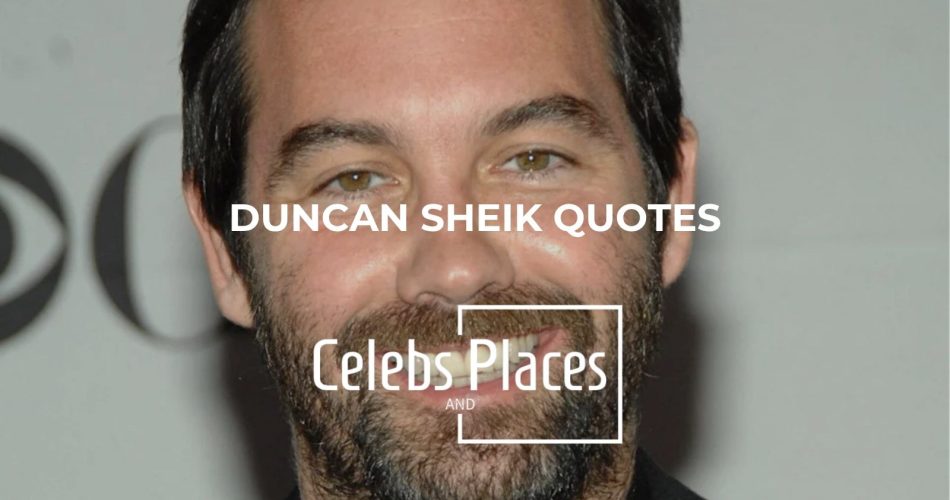
Duncan Sheik wasn’t just a one-hit pop singer; he was a restless, Grammy-nominated songwriter who spent three decades chasing sound wherever it led him, from a breakout radio hit to a genre-defining Broadway score. He built a career on refusing to repeat himself, moving from the aching acoustic pop of his 1996 debut into orchestral art-rock, Nichiren Buddhist-inflected songwriting, and eventually the celebrated musical theater work that earned him two Tony Awards and a devoted following far beyond the charts. Duncan Sheik died on September 17, 2026, at the age of 56, and the tributes pouring in from fellow musicians, Broadway collaborators, and fans who grew up on “Barely Breathing” reflect a career built on quiet persistence rather than easy fame. These Duncan Sheik quotes, drawn from decades of interviews, offer a glimpse into the mind of an artist who valued craft over hits and inner conviction over trends.
Who Was Duncan Sheik?
Duncan Scott Sheik was born on November 18, 1969, in Montclair, New Jersey. After his parents divorced, he split his childhood between his father’s home in New Jersey and his mother’s in South Carolina, an upbringing shaped early by music thanks to a Juilliard-trained grandmother who introduced him to the piano. He picked up guitar as a boy and was playing in a cover band with older high school musicians by the time he was twelve. He attended Phillips Academy in Andover, Massachusetts, before enrolling at Brown University, where he studied semiotics and played guitar alongside a young Lisa Loeb in a college band, graduating in 1992 before moving to Los Angeles to chase a career in music.
Sheik’s self-titled 1996 debut album went gold on the strength of “Barely Breathing,” a brooding, acoustic-driven single that spent 55 weeks on the Billboard Hot 100 and earned him a Grammy nomination for Best Male Pop Vocal Performance. Rather than chase a follow-up hit, he spent the following decade experimenting with orchestral pop, Nick Drake-inspired folk, and electronic textures, all while deepening a Nichiren Buddhist practice that he said kept him from ever running short on inspiration. His most significant creative leap arrived in 2006, when a nearly decade-long collaboration with playwright Steven Sater on the musical Spring Awakening opened on Broadway. The show, adapted from Frank Wedekind’s controversial German play, won eight Tony Awards including Best Musical, with Sheik personally receiving the Tony for Best Original Score and Best Orchestrations, along with a Grammy Award for Best Musical Show Album. He went on to compose the scores for American Psycho and Alice by Heart, proving that his early instinct to follow the music wherever it led had opened an entire second career on the stage.
In his later years, Sheik continued to release solo albums, including Legerdemain in 2015 and Claptrap in 2022, while remaining active in musical theater. He was married to Nora Ariffin, a former model turned real estate professional, and the couple raised a daughter, Ines, largely outside the public eye. Duncan Sheik died on September 17, 2026, at the age of 56, according to his family, marking the end of an era for a songwriter who spent his career quietly refusing to be defined by a single hit. He leaves behind a body of work that stretches from a Billboard chart-topper to one of the most decorated scores in modern Broadway history, a testament to an artist who always trusted where the music wanted to go.

Inspiring Duncan Sheik Quotes on Songwriting, Sound, and the Creative Process
When Duncan Sheik talked about his own music, he rarely reached for grand statements. He talked instead about craft: the arrangement choices, the discipline of writing within a pop single’s rigid structure, and the moments when a chord progression would arrive fully formed on a walk and refuse to leave him alone until it became a song. He resisted easy hits in favor of the records he actually wanted to make, trusting his own ear over the industry’s expectations, and that same instinct for sound over spectacle is what eventually carried him from three-minute singles into a fully orchestrated Broadway score. These quotes reveal a songwriter who treated the studio less as a business and more as a place to chase whatever sound was already living in his head.
- “I make the kind of music I like.” – Duncan Sheik
- “My first two records were more energetic; Phantom Moon is subtle, quiet; so these various reactions are just something I expected.” – Duncan Sheik
- “So, once I’ve written a song, you know, I’m pretty happy with what the song is on its own terms.” – Duncan Sheik
- “But I can’t really say there is too much modern music that I’m blown away by at this moment.” – Duncan Sheik
- “I privilege the music over the lyrics.” – Duncan Sheik
- “I’m fortunate I have this coterie of musicians around me to help take music to next level. Being surrounded by so much creative energy, so many creative people really feeds that creativity in me.” – Duncan Sheik
- “My second record was all about big ideas; I was trying to make big statements about the culture, about life. I think in a certain way, I was a 27 year old kid with a guitar.” – Duncan Sheik
- “I mean, at the end of the day when I’m making a record, what I want to do is what I do.” – Duncan Sheik
- “Things come to me pretty regularly. There is never a shortage or a backlog.” – Duncan Sheik
- “The difficult thing about a pop record is that you’re given guidelines: it has to have 3 choruses, and then it must be between 3 minutes fifteen seconds and three minutes forty-five seconds.” – Duncan Sheik
- “Simon Hale, the British arranger, does all string and wood arrangements on my records.” – Duncan Sheik
- “I’m a pretty big P.J. Harvey record fan and you can really hear New York in his record.” – Duncan Sheik
- “But really important, perhaps most important is the craft; how you make your record, the creation of these sonic worlds you want your listener to hear.” – Duncan Sheik
- “Ultimately, if I’m really moved by something, it’s going to go on the record and that’s that.” – Duncan Sheik
- “For my second record I had gotten ProTools and started to familiarize myself with hard disc recording.” – Duncan Sheik
- “Happy music doesn’t tend to move me much.” – Duncan Sheik
- “I’d have these weird experiences where I’d just be walking down the street with this chord progression in my head; this happened more than a few times, and I’d walk home and find a fax in my machine and it would match the music in my head.” – Duncan Sheik
- “I actually am always a music first person.” – Duncan Sheik
- “Emerson, Lake & Palmer or King Crimson or Gentle Giant; the worst prog rock references I can come up with. Though I totally loved those groups as a kid.” – Duncan Sheik
- “When I was a teenager, I got into four track recorders, drum machines, and synthesizers, and I started producing instrumental music.” – Duncan Sheik
- “I did a song, ‘Court and Spark,’ for a Joni Mitchell tribute album that’s yet to see the light of day. So she’s someone I’d like to do something with, sure. I worked with the great guitar player Bill Frisell on Phantom Moon; that was fun. I’m such a fan; he’s amazing.” – Duncan Sheik
Reflective Duncan Sheik Quotes on Faith, Life, and the Journey Behind the Music
Away from the studio, Sheik spoke often about the quieter forces that shaped his work: a Nichiren Buddhist practice he took up as a teenager, a clear-eyed honesty about the industry’s unpredictability, and a refusal to dramatize a life he considered, by his own account, fortunate rather than tortured. He talked about beauty in sadness, about naivety in the years before fame found him, and about a spiritual practice that he credited with keeping his creative well from ever running dry. These reflections show a musician who understood his career as one small part of a longer, more grounded search for meaning.
- “I actually think sadness and darkness can be very beautiful and healing.” – Duncan Sheik
- “The experiences of promoting my first album were really something; there is so much illusion in my environment (touring and pop music) that I wanted to clear away.” – Duncan Sheik
- “A real foolproof way to do it is play your stuff by hook or by crook and build up a grass roots following.” – Duncan Sheik
- “I also wanted to make a record that was about other things than romance; after two years on the road singing all the songs from the first album, I got kind of tired of that.” – Duncan Sheik
- “If I were to do this over I’d play a lot more shows before I made a record.” – Duncan Sheik
- “And frankly, when I made that record, hit songs were not what I was trying to achieve.” – Duncan Sheik
- “I started playing music at a pretty young age.” – Duncan Sheik
- “I try to make sure that the Buddhism is more or less implicit in the music rather than explicit.” – Duncan Sheik
- “Lately I’ve been a workaholic. I’m in the studio all the time and I’ve helped to produce a couple of artists.” – Duncan Sheik
- “I think my Buddhist practice has a profound influence on my life and encompasses my creative projects.” – Duncan Sheik
- “I feel fortunate about being able to make the music I want to make and getting away with it.” – Duncan Sheik
- “I got a publishing deal with BMG, they were supportive, and some money to record demos.” – Duncan Sheik
- “I certainly wouldn’t say that my life is a disaster, but there have been moments where I’ve felt like that.” – Duncan Sheik
- “I wouldn’t say that I’ve had a tough life by any stretch of the imagination.” – Duncan Sheik
- “So I started chanting when I was nineteen, which was about twelve years ago, and it really had a huge impact on my outlook, happiness, and general creativity.” – Duncan Sheik
- “It’s inevitable your environment will influence what you do.” – Duncan Sheik
- “I think in a way I was probably completely naive about what it takes to make something become a hit.” – Duncan Sheik
- “Because of my Buddhist practice, I’m never lacking for inspiration.” – Duncan Sheik
Final Thoughts
What comes through across Duncan Sheik’s own words is an artist who never mistook a single hit for a finished story. He talked about music with the patience of a craftsman, weighing arrangements and structure as carefully as any lyric, and he treated his Buddhist practice not as a footnote but as the quiet engine behind everything he made. His insights remind us that lasting work rarely comes from chasing what already works; it comes from following an idea, a chord, or a feeling of sadness or beauty, wherever it actually wants to go.
In an industry that often rewards repetition, Sheik’s journey from a radio-ready pop singer to one of Broadway’s most decorated composers stands as proof that reinvention can be its own kind of integrity. His wisdom about craft, patience, and creative honesty still resonates for anyone trying to build something that outlasts a single moment of popularity, and his music, from “Barely Breathing” to the score of Spring Awakening, will keep offering new listeners a way into that same searching, restless spirit.