
A glove-maker’s son from a small English market town somehow managed to capture the entire human experience in thirty-seven plays and 154 sonnets. William Shakespeare’s journey from Stratford-upon-Avon to becoming the most influential writer in history remains as mysterious as it is remarkable, with large gaps in the historical record only adding to his legend. What we do know is that his work has survived four centuries of changing tastes, political upheavals, and cultural revolutions because he understood something fundamental about humanity that transcends time and place. Shakespeare didn’t just write about kings and lovers, witches and fools; he dissected jealousy, ambition, grief, and joy with such precision that his insights feel as fresh today as they did in Elizabethan England. His phrases have become so embedded in English that we quote him without knowing it, speaking of “wild goose chases,” “heart of gold,” and “the world’s my oyster” as if they were always part of our language. These Shakespeare quotes reveal why his work endures: he wrote not for his age but for all ages, capturing truths about human nature that remain constant regardless of how much the world around us changes.
Who Was William Shakespeare?
Born in April 1564 in Stratford-upon-Avon, England, William Shakespeare was the son of John Shakespeare, a successful glove maker and local official, and Mary Arden, who came from a prosperous farming family. His childhood in this market town provided him with exposure to both rural life and the commercial activities that would later inform the diverse settings and characters of his plays. He received a solid education at the local grammar school, where he studied Latin, classical literature, and rhetoric, though he never attended university. At age 18, he married Anne Hathaway, who was eight years his senior and already pregnant with their first child, beginning a family life that would remain rooted in Stratford even as his professional career took him to London.
Shakespeare’s emergence as a playwright and actor in London during the late 1580s and early 1590s coincided with the golden age of English theater, when public playhouses were drawing diverse audiences hungry for entertainment and artistic expression. His early works included comedies like “The Comedy of Errors” and history plays chronicling English kings, but he soon expanded his range to include the great tragedies such as “Hamlet,” “Othello,” “King Lear,” and “Macbeth” that would cement his reputation as the greatest dramatist in the English language. His success allowed him to become a shareholder in the Lord Chamberlain’s Men, later the King’s Men, one of London’s leading theater companies, providing him with financial security and creative freedom. His plays were performed at the Globe Theatre and later at the indoor Blackfriars Theatre, reaching audiences from all levels of society.
After writing approximately 38 plays and 154 sonnets, Shakespeare retired to Stratford around 1613, where he lived as a prosperous gentleman until his death on April 23, 1616, at the age of 52. The cause of his death remains unknown, though various theories have been proposed over the centuries. His legacy was preserved through the publication of the First Folio in 1623 by his fellow actors, which collected 36 of his plays and ensured their survival for future generations. His influence on literature, theater, and the English language itself cannot be overstated, as his works continue to be performed, studied, and quoted more than any other writer in history, demonstrating the universal and enduring nature of his insights into the human condition.
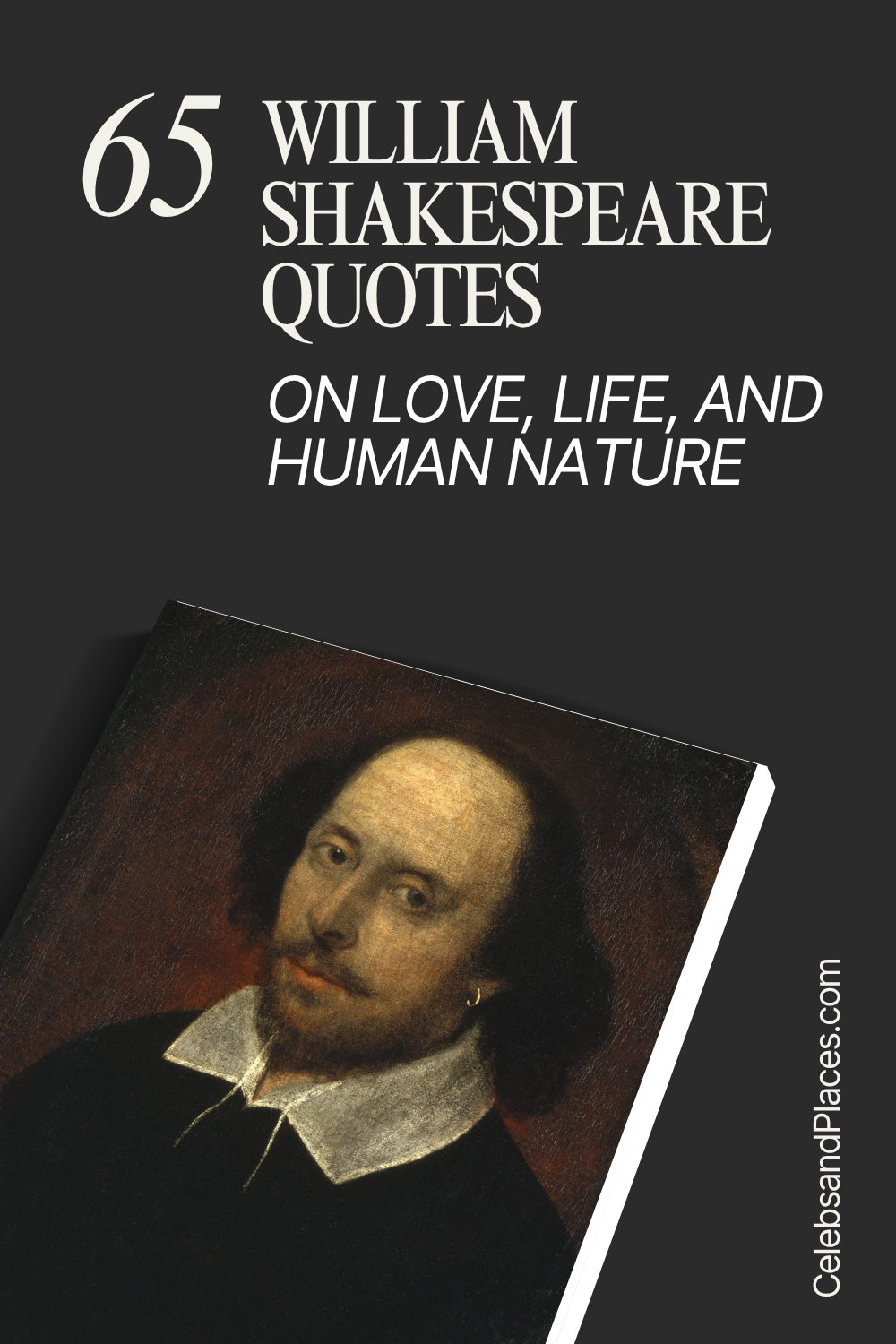
Inspiring Shakespeare Quotes
William Shakespeare’s inspirational wisdom emerged from his deep observation of human behavior and his understanding that people’s fundamental hopes, dreams, and struggles remain constant across time and circumstance. Having created hundreds of characters from all walks of life, he developed an unmatched ability to articulate the inner thoughts and feelings that define the human experience, from the courage required to face adversity to the joy of genuine love. His philosophy emphasized that life’s meaning comes not from external circumstances but from how we respond to challenges and opportunities with integrity, compassion, and authenticity. These quotes reflect his belief that every person possesses the capacity for greatness and that our choices, more than our circumstances, determine who we become and what legacy we leave behind.
- “To be, or not to be, that is the question.” – William Shakespeare
- “All the world’s a stage, and all the men and women merely players.” – William Shakespeare
- “This above all: to thine own self be true.” – William Shakespeare
- “The course of true love never did run smooth.” – William Shakespeare
- “Brevity is the soul of wit.” – William Shakespeare
- “What’s in a name? That which we call a rose by any other name would smell as sweet.” – William Shakespeare
- “There is nothing either good or bad, but thinking makes it so.” – William Shakespeare
- “We know what we are, but know not what we may be.” – William Shakespeare
- “The better part of valor is discretion.” – William Shakespeare
- “Some are born great, some achieve greatness, and some have greatness thrust upon them.” – William Shakespeare
- “Cowards die many times before their deaths; the valiant never taste of death but once.” – William Shakespeare
- “Love all, trust a few, do wrong to none.” – William Shakespeare
- “The fault, dear Brutus, is not in our stars, but in ourselves.” – William Shakespeare
- “If music be the food of love, play on.” – William Shakespeare
- “A fool thinks himself to be wise, but a wise man knows himself to be a fool.” – William Shakespeare
- “It is not in the stars to hold our destiny but in ourselves.” – William Shakespeare
- “Give me my robe, put on my crown; I have immortal longings in me.” – William Shakespeare
- “Expectation is the root of all heartache.” – William Shakespeare
- “The robbed that smiles, steals something from the thief.” – William Shakespeare
- “When sorrows come, they come not single spies, but in battalions.” – William Shakespeare
- “Our doubts are traitors, and make us lose the good we oft might win, by fearing to attempt.” – William Shakespeare
- “The lady doth protest too much, methinks.” – William Shakespeare
- “Though she be but little, she is fierce.” – William Shakespeare
- “To thine own self be true, and it must follow, as the night the day, thou canst not then be false to any man.” – William Shakespeare
- “The very substance of the ambitious is merely the shadow of a dream.” – William Shakespeare
- “Hell is empty and all the devils are here.” – William Shakespeare
- “Lord, what fools these mortals be!” – William Shakespeare
- “The empty vessel makes the loudest sound.” – William Shakespeare
- “We are such stuff as dreams are made on, and our little life is rounded with a sleep.” – William Shakespeare
- “There are more things in heaven and earth, Horatio, than are dreamt of in your philosophy.” – William Shakespeare
- “Let me not to the marriage of true minds admit impediments.” – William Shakespeare
- “A horse! A horse! My kingdom for a horse!” – William Shakespeare
- “Uneasy lies the head that wears a crown.” – William Shakespeare
More Powerful Quotes by William Shakespeare
Shakespeare’s most profound insights often centered on the darker aspects of human nature and the tragic consequences that arise from unchecked ambition, jealousy, and moral weakness. Throughout his great tragedies and complex histories, he explored how power corrupts, how love can transform into destructive obsession, and how the seeds of our destruction often lie within our own character flaws. His understanding of psychology was remarkably sophisticated for his era, revealing the complex motivations that drive human behavior and the internal conflicts that torment those who betray their better nature. These quotes reflect his recognition that life’s greatest dramas unfold within the human heart, where desire battles with duty, ambition struggles against conscience, and the capacity for both nobility and savagery coexist in perpetual tension.
- “Something is rotten in the state of Denmark.” – William Shakespeare
- “Now is the winter of our discontent.” – William Shakespeare
- “Out, out, brief candle! Life’s but a walking shadow, a poor player that struts and frets his hour upon the stage and then is heard no more.” – William Shakespeare
- “By the pricking of my thumbs, something wicked this way comes.” – William Shakespeare
- “Double, double toil and trouble; fire burn and caldron bubble.” – William Shakespeare
- “Fair is foul, and foul is fair.” – William Shakespeare
- “Frailty, thy name is woman!” – William Shakespeare
- “Neither a borrower nor a lender be.” – William Shakespeare
- “The quality of mercy is not strained.” – William Shakespeare
- “All that glisters is not gold.” – William Shakespeare
- “Parting is such sweet sorrow.” – William Shakespeare
- “A plague o’ both your houses!” – William Shakespeare
- “Good night, good night! Parting is such sweet sorrow, that I shall say good night till it be morrow.” – William Shakespeare
- “These violent delights have violent ends.” – William Shakespeare
- “My words fly up, my thoughts remain below: Words without thoughts never to heaven go.” – William Shakespeare
- “Madness in great ones must not unwatched go.” – William Shakespeare
- “Rich gifts wax poor when givers prove unkind.” – William Shakespeare
- “The rest is silence.” – William Shakespeare
- “I am not merry, but I do beguile the thing I am by seeming otherwise.” – William Shakespeare
- “Men at some time are masters of their fates.” – William Shakespeare
- “Et tu, Brute?” – William Shakespeare
- “Friends, Romans, countrymen, lend me your ears; I come to bury Caesar, not to praise him.” – William Shakespeare
- “Cry havoc and let slip the dogs of war!” – William Shakespeare
- “Beware the ides of March.” – William Shakespeare
- “O, beware, my lord, of jealousy; It is the green-eyed monster which doth mock the meat it feeds on.” – William Shakespeare
- “Put out the light, and then put out the light.” – William Shakespeare
- “What’s done is done.” – William Shakespeare
- “Is this a dagger which I see before me?” – William Shakespeare
- “Out, damned spot! Out, I say!” – William Shakespeare
- “Life’s but a walking shadow, a poor player, that struts and frets his hour upon the stage, and then is heard no more; it is a tale told by an idiot, full of sound and fury, signifying nothing.” – William Shakespeare
- “Reputation is an idle and most false imposition; oft got without merit, and lost without deserving.” – William Shakespeare
- “How sharper than a serpent’s tooth it is to have a thankless child!” – William Shakespeare
Final Thoughts
William Shakespeare represented the pinnacle of literary achievement, demonstrating an understanding of human nature that remains unsurpassed in its depth, nuance, and universal applicability. His words reflect a writer who recognized that beneath the costumes and customs of different eras, people experience the same fundamental emotions and face the same essential choices between good and evil, courage and cowardice, love and hatred. Throughout his extraordinary body of work, he created a mirror in which humanity could see itself with unprecedented clarity, revealing both our capacity for transcendent nobility and our susceptibility to destructive passions.
In our modern world, Shakespeare’s wisdom continues to illuminate the timeless aspects of human experience that technology and social change cannot alter. His insights into ambition, jealousy, love, and power remain as relevant in today’s boardrooms and relationships as they were in Renaissance courts and households. Whether exploring the corrupting influence of unchecked ambition or celebrating the transformative power of genuine love, his works remind us that the fundamental questions of how to live meaningfully and relate authentically to others are eternal, offering guidance and understanding to each new generation seeking to navigate the complexities of the human condition.