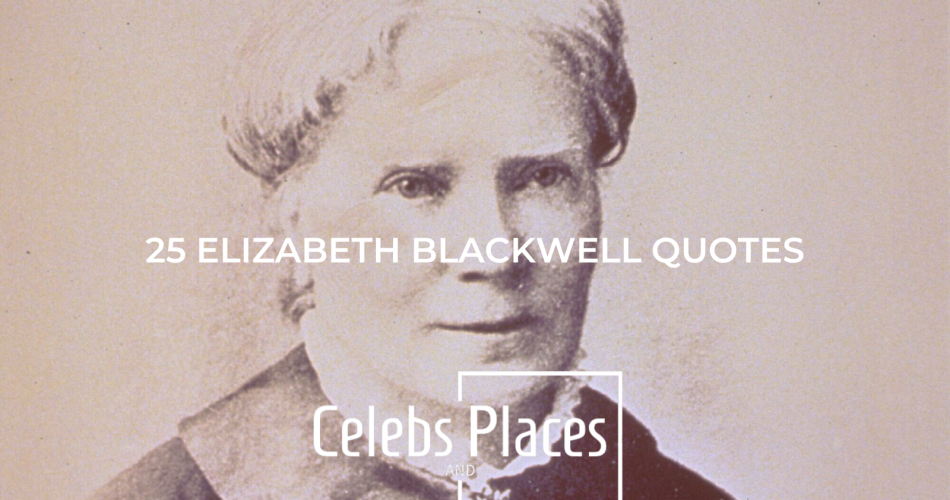
Elizabeth Blackwell’s legacy is one of bold defiance against societal norms and a pioneering spirit that reshaped the medical world. As the first woman to receive a medical degree in the United States, she paved the way for generations of female physicians. Her words carry the weight of a revolutionary mind who not only broke barriers but also inspired others to rise above limitations, pursue justice, and serve humanity.
Who was Elizabeth Blackwell?
Elizabeth Blackwell was born in 1821 in Bristol, England, and immigrated with her family to the United States in her youth. Driven by intellectual curiosity and a deep moral compass, she set her sights on the seemingly impossible: becoming a doctor in a time when women were considered unfit for medical practice. Rejected by numerous schools, she was eventually accepted by Geneva Medical College in New York—more as a joke than a genuine opportunity. Yet she persisted, graduating in 1849 and becoming the first woman to earn a medical degree in the U.S.
Blackwell didn’t stop at personal triumph. She used her platform to challenge institutional sexism in medicine and advocate for public health and preventive care, especially for women and children. She co-founded the New York Infirmary for Indigent Women and Children, offering both treatment and medical training. Later, she helped establish the London School of Medicine for Women, ensuring the legacy of female education in healthcare extended across continents.
More than a physician, Elizabeth was a writer, educator, and activist. She believed in a holistic vision of health that combined physical, moral, and social well-being. Her voice—firm, compassionate, and forward-thinking—echoes through time as a beacon of resilience and integrity. She opened doors and lit the way for others, not with anger, but with unwavering belief in the right to equality and opportunity.

Inspiring Elizabeth Blackwell Quotes
Elizabeth was not only a medical pioneer but also a visionary thinker. Her reflections on love, hope, and spiritual strength reveal her belief that human progress stems from virtues not seen with the eye, but felt deeply in the soul. She saw medicine not just as a science but as a service—one inextricably tied to compassion, ethics, and social reform. Her connection with figures like Florence Nightingale only deepened her resolve that health, sanitation, and morality must go hand in hand.
Throughout her life, Elizabeth championed the importance of purpose and education. She understood that every experience, especially the challenging ones, are necessary for discovering one’s true strength. She spoke with conviction about the transformative power of knowledge, not just for personal growth, but for collective advancement. Her vision extended far beyond herself—she believed that what one woman achieved could elevate all women, making progress a shared legacy.
Elizabeth never sought fame, but rather fulfillment. She recognized the burden of regrets and the silence surrounding everyday heroes. Still, she chose a path of purpose over comfort, driven by a responsibility to those who would come after her. Her belief in equal education for women and her refusal to settle for second-best echoed her unwavering integrity. Her life reminds us that progress is not born from ease, but from unrelenting courage and selfless dedication.
- “Love, Hope, and Reverence are realities of a different order from the senses, but they are positive and constant facts, always active, always working out mighty changes in human life.” – Elizabeth Blackwell
- “To her [Florence Nightingale] chiefly I owed the awakening to the fact that sanitation is the supreme goal of medicine its foundation and its crown.” – Elizabeth Blackwell
- “None of us can know what we are capable of until we are tested.” – Elizabeth Blackwell
- “When life follows the course of our desires, it is easy to be swept along without thought.” – Elizabeth Blackwell
- “For what is done or learned by one class of women becomes, by virtue of their common womanhood, the property of all women.” – Elizabeth Blackwell
- “Health has its science, as well as disease.”— Elizabeth Blackwell

- “…I awoke with a renewed understanding of why it is wise to retire to bed come nightfall. For evil thoughts take strength from the dark, while hope thrives in the light.” – Elizabeth Blackwell
- Medicine is so broad a field, so closely interwoven with general interests, dealing as it does with all ages, sexes and classes, and yet of so personal a character in its individual appreciations, that it must be regarded as one of those great departments of work in which the cooperation of men and women is needed to fulfill all its requirements.” – Elizabeth Blackwell
- “I am not the sort of person about whom stories are told. Those of humble birth suffer their heartbreaks and celebrate their triumphs unnoticed by the bards, leaving no trave in the fables of their time.” – Elizabeth Blackwell
- “The clear perception of the providential call to women to take their full share in human progress has always led us to insist upon a full and identical medical education for our students. From the beginning in America, and later on in England, we have always refused to be tempted by specious offers urged upon us to be satisfied with partial or specialised instruction.” – Elizabeth Blackwell
- “In her eyes I saw the pain that comes from regrets that will never be lifted.” – Elizabeth Blackwell
- “I, who so love a hermit life for a good part of the day, find myself living in public, and almost losing my identity.”— Elizabeth Blackwell
Related Post: 55 Sally Ride Quotes to Fuel Your Drive to Achieve Greatness

More Famous Quotes by Elizabeth Blackwell
Elizabeth Blackwell was no stranger to inner conflict, societal barriers, and emotional isolation. She often confronted the duality of life: the protective walls that also imprison, the fleeting nature of happiness, and the high cost of moral clarity. For Elizabeth, threats did not always come from the outside world—they could lie hidden within familiar systems, cloaked in civility and tradition. Her understanding of human vulnerability and hidden danger made her a profoundly observant voice in an era dominated by appearances and decorum.
For Elizabeth Blackwell, medicine was not just a profession—it was a battleground for ethics, autonomy, and the reclamation of womanhood. She rejected the distortion of female physicians as agents of shame, instead championing their potential as agents of healing and integrity. To her, a woman’s development—intellectually, morally, and professionally—was not just a personal right but a public necessity. If society resisted, then society, not women, needed to change.
Elizabeth Blackwell was a pioneer, and she understood that blazing a trail meant enduring solitude. She bore the professional coldness of her time with remarkable tenacity, drawing strength from the purity of her mission. The vacuum she described was not just emotional—it was structural, spiritual, and cultural. Yet even in her hardest moments, she found motivation in the moral clarity of her purpose. Her hope in human goodness, even when surrounded by systemic indifference, allowed her to press forward. She didn’t just chase titles; she pursued transformation, both personal and societal, lighting the way for generations to follow.
- “Most saw those walls as protection from danger, but I had recognized, somewhere deep in my soul, that not all threats came from without.” – Elizabeth Blackwell
- “If I were rich I would not begin private practice, but would only experiment; as, however, I am poor, I have no choice.” – Elizabeth Blackwell
- “Do not be fooled by the fine manners. At court, enemies hide in plain sight.” – Elizabeth Blackwell
- “But happiness, fleeting by nature, is often savored only after it has flown.” – Elizabeth Blackwell
- “Every great legend is at its heart a tale of innocence lost, and perhaps that was the role I was destined to play.” – Elizabeth Blackwell
- “The gross perversion and destruction of motherhood by the abortionist filled me with indignation, and awakened active antagonism. That the honourable term ‘female physician’ should be exclusively applied to those women who carried on this shocking trade seemed to me a horror. It was an utter degradation of what might and should become a noble position for women.” – Elizabeth Blackwell
- “If society will not admit of woman’s free development, then society must be remodeled.” – Elizabeth Blackwell

- “Our school education ignores, in a thousand ways, the rules of healthy development.” – Elizabeth Blackwell
- “A blank wall of social and professional antagonism faces the woman physician that forms a situation of singular and painful loneliness, leaving her without support, respect, or professional counsel.” – Elizabeth Blackwell
- “It is not easy to be a pioneer – but oh, it is fascinating! I would not trade one moment, even the worst moment, for all the riches in the world.” – Elizabeth Blackwell
- “I must have something to engross my thoughts, some object in life which will fill this vacuum, and prevent this sad wearing away of the heart.” – Elizabeth Blackwell
- “The idea of winning a doctor’s degree gradually assumed the aspect of a great moral struggle, and the moral fight possessed immense attraction for me.” – Elizabeth Blackwell
- “My hope rises when I find that the inner heart of a human being may remain pure, notwithstanding some corruption of the outer coverings.” – Elizabeth Blackwell
- “I felt more than ever the necessity of my mission. But I went home out of spirits, I hardly know why. I must work by myself all life long.” – Elizabeth Blackwell
Final Thoughts
Elizabeth Blackwell was more than the first woman in America to earn a medical degree—she was a visionary who believed in the dignity of purpose and the power of persistence. Her life was a testament to what it means to stand firm in the face of resistance, to lead with conviction when encouragement is scarce, and to dedicate oneself fully to a cause greater than personal gain. Every quote, every decision, and every battle she fought revealed a soul deeply committed to progress—not just for herself but for all women.
Her legacy lives on in every woman who dares to defy convention, in every mind shaped by education, and in every hand that heals. Elizabeth Blackwell opened doors not simply with her achievements but with her unwavering belief that society could—and must—evolve to honor the contributions of women. Her words still echo with power, reminding us that real change begins with courage, and that pioneers may walk alone—but they never walk in vain.