Frederick Douglass, an escaped slave turned influential abolitionist, was a powerful orator and a leading figure in the fight for equality and justice. His words transcended his era, serving as beacons of intelligence and humanity that resonate with our struggles for freedom and rights even today. Celebrate his profound wisdom and enduring spirit with these 50 memorable quotes, perfect for reflecting upon or for sharing with anyone seeking historical inspiration.
Who is Frederick Douglass?
Frederick Douglass was born as Frederick Augustus Washington Bailey in Talbot County, Maryland. He never knew his exact birth date, but he later chose to celebrate it on February 14. At a young age, he was separated from his mother and raised by his grandmother on a plantation. Despite facing unimaginable hardships and cruelty as a slave, Douglass taught himself how to read and write. This newfound knowledge empowered him with a deep understanding of the injustices he faced and fueled his desire for freedom.
As a young man, Douglass managed to escape slavery in 1838 by disguising himself as a sailor and fleeing to New York City. He adopted the surname “Douglass” as an homage to Sir Walter Scott’s poem “The Lady of the Lake.” In New York, he became involved in anti-slavery activism and quickly gained recognition for his eloquent speeches denouncing slavery. His autobiography, “Narrative of the Life of Frederick Douglass,” published in 1845, further solidified his reputation as a powerful voice against oppression.
Throughout his life, Frederick Douglass tirelessly fought for the abolition of slavery and equal rights for all individuals. He was a key figure in both the abolitionist movement and the women’s suffrage movement. He believed that true freedom could only be achieved through education, self-reliance, and moral improvement. His speeches captivated audiences across America and Europe, challenging societal norms and advocating for social change.
Douglass’s impact extended beyond his activism; he also served as an advisor to President Abraham Lincoln during the Civil War and held various government positions after emancipation. He continued to champion civil rights until his death in 1895. Today, Frederick Douglass’s legacy lives on through his writings, speeches, and advocacy work. His words remain relevant as we continue to confront issues of systemic racism and inequality in our society.
You may also like:
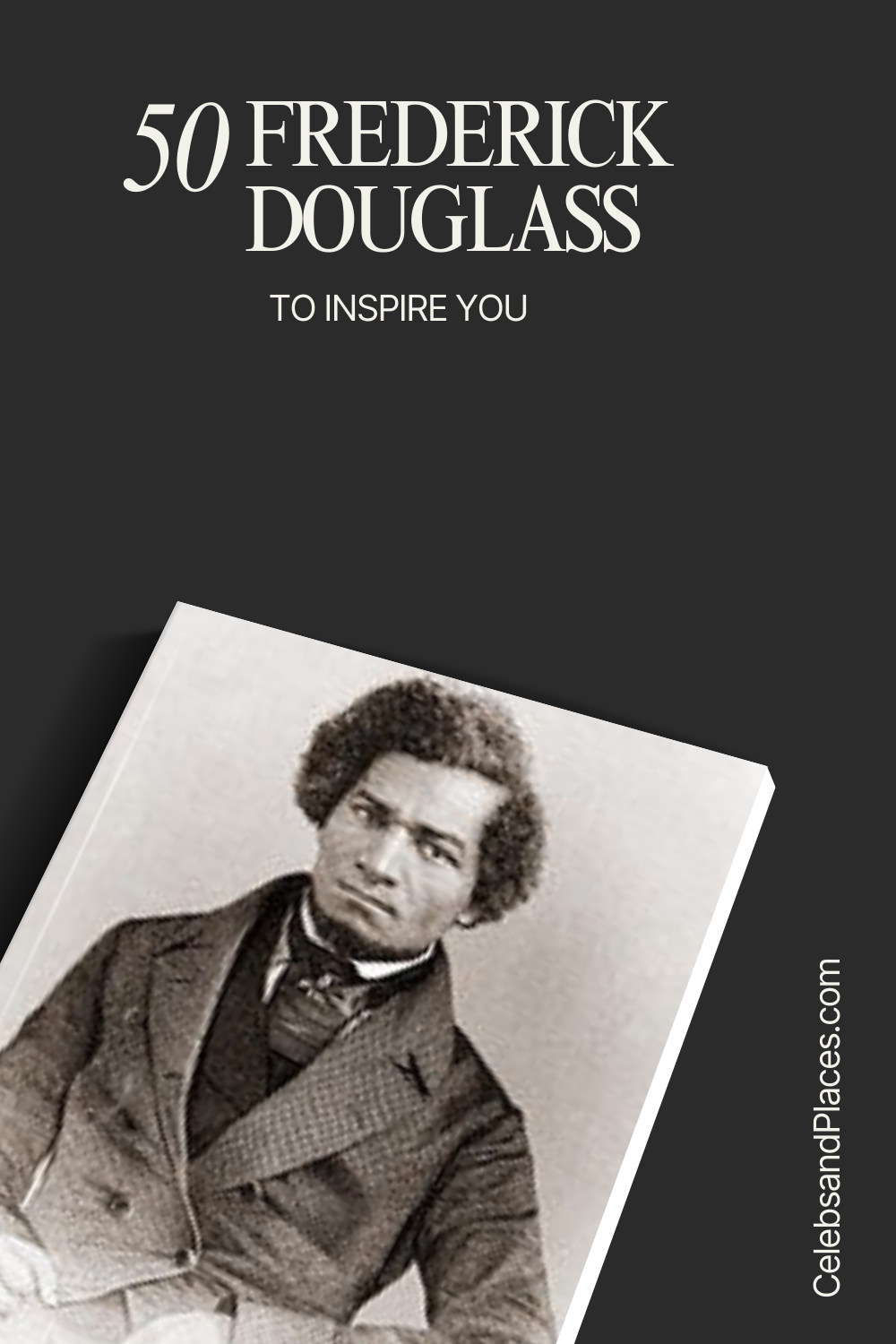
Frederick Douglass Quotes
- “Knowledge makes a man unfit to be a slave.”
- “Education means emancipation. It means light and liberty. It means the uplifting of the soul of man into the glorious light of truth, the light by which men can only be made free.”
- “In all my interviews with Mr. Lincoln I was impressed with his entire freedom from popular prejudice against the colored race. He was the first great man that I talked with in the United States freely, who in no single instance reminded me of the difference between himself and myself, of the difference of color…”
- “My natural elasticity was crushed, my intellect languished, the disposition to read departed, the cheerful spark that lingered about my eye died; the dark night of slavery closed in upon me; and behold a man transformed into a brute!”
- “Once you learn to read, you will be forever free.”
- “It is easier to build strong children than to repair broken men.”
- “I prefer to be true to myself, even at the hazard of incurring the ridicule of others, rather than to be false, and to incur my own abhorrence.”
- “If there is no struggle, there is no progress. Those who profess to favor freedom, and yet depreciate agitation, are men who want crops without plowing up the ground. They want rain without thunder and lightning. They want the ocean without the awful roar of its many waters. This struggle may be a moral one; or it may be a physical one; or it may be both moral and physical; but it must be a struggle. Power concedes nothing without a demand. It never did and it never will.”
- “Where justice is denied, where poverty is enforced, where ignorance prevails, and where any one class is made to feel that society is an organized conspiracy to oppress, rob and degrade them, neither persons nor property will be safe.”
- “Those who profess to favor freedom and yet depreciate agitation, are people who want crops without ploughing the ground; they want rain without thunder and lightning; they want the ocean without the roar of its many waters. The struggle may be a moral one, or it may be a physical one, or it may be both. But it must be a struggle. Power concedes nothing without a demand. It never did and it never will.”

- “I prayed for freedom for twenty years, but received no answer until I prayed with my legs.”
- “The white man’s happiness cannot be purchased by the black man’s misery.”
- “To suppress free speech is a double wrong. It violates the rights of the hearer as well as those of the speaker.”
- “Power concedes nothing without a demand. It never did and it never will. Find out just what any people will quietly submit to and you have found out the exact measure of injustice and wrong which will be imposed upon them, and these will continue till they are resisted with either words or blows, or with both. The limits of tyrants are prescribed by the endurance of those whom they oppress.”
- “In thinking of America, I sometimes find myself admiring her bright blue sky — her grand old woods — her fertile fields — her beautiful rivers — her mighty lakes, and star-crowned mountains. But my rapture is soon checked, my joy is soon turned to mourning. When I remember that all is cursed with the infernal actions of slaveholding, robbery and wrong, — when I remember that with the waters of her noblest rivers, the tears of my brethren are borne to the ocean, disregarded and forgotten, and that her most fertile fields drink daily of the warm blood of my outraged sisters, I am filled with unutterable loathing.”
- “People might not get all they work for in this world, but they must certainly work for all they get.”
- “Power concedes nothing without a demand. It never did and it never will.”
- “I would unite with anybody to do right and with nobody to do wrong.”
- “I have observed this in my experience of slavery,–that whenever my condition was improved, instead of its increasing my contentment, it only increased my desire to be free, and set me to thinking of plans to gain my freedom. I have found that, to make a contented slave, it is necessary to make a thoughtless one. It is necessary to darken his moral and mental vision, and, as far as possible, to annihilate the power of reason. He must be able to detect no inconsistencies in slavery; he must be made to feel that slavery is right; and he can be brought to that only when he ceased to be a man.”
- “It is not light that we need, but fire; it is not the gentle shower, but thunder. We need the storm, the whirlwind, and the earthquake.”

- “This struggle may be a moral one, or it may be a physical one, and it may be both moral and physical, but it must be a struggle. Power concedes nothing without a demand. It never did and it never will. Find out just what any people will quietly submit to and you have found out the exact measure of injustice and wrong which will be imposed upon them, and these will continue till they are resisted with either words or blows, or with both. The limits of tyrants are prescribed by the endurance of those whom they oppress. In the light of these ideas, Negroes will be hunted at the North, and held and flogged at the South so long as they submit to those devilish outrages, and make no resistance, either moral or physical. Men may not get all they pay for in this world; but they must certainly pay for all they get. If we ever get free from the oppressions and wrongs heaped upon us, we must pay for their removal. We must do this by labor, by suffering, by sacrifice, and if needs be, by our lives and the lives of others.”
- “Slaves sing most when they are most unhappy. The songs of the slave represent the sorrows of his heart; and he is relieved by them, only as an aching heart is relieved by its tears.”
- The more I read, the more I was led to abhor and detest my enslavers. I could regard them in no other light than a band of successful robbers, who had left their homes, and gone to Africa, and stolen us from our homes, and in a strange land reduced us to slavery. I loathed them as being the meanest as well as the most wicked of men. As I read and contemplated the subject, behold! that very discontentment which Master Hugh had predicted would follow my learning to read had already come, to torment and sting my soul to unutterable anguish. As I writhed under it, I would at times feel that learning to read had been a curse rather than a blessing. It had given me a view of my wretched condition, without the remedy. it opened my eyes to the horrible pit, but to no ladder upon which to get out. in moments of agony, I envied my fellow-slaves for their stupidity. I have often wished myself a beast. I preferred the condition of the meanest reptile to my own. Any thing, no matter what, to get rid of thinking! It was this everlasting thinking of my condition that tormented me. There was no getting rid of it. It was pressed upon me by every object within sight or hearing, animate or inanimate. The silver trump of freedom had roused my soul to eternal wakefulness. Freedom now appeared, to disappear no more forever. It was heard in every sound and seen in every thing. It was ever present to torment me with a sense of my wretched condition. I saw nothing without seeing it, I heard nothing without hearing it, and felt nothing without feeling it. It looked from every star, it smiled in every calm, breathed in every wind, and moved in every storm.”
- “No man can put a chain about the ankle of his fellow man without at last finding the other end fastened about his own neck.”
- “The marriage institution cannot exist among slaves, and one sixth of the population of democratic America is denied it’s privileges by the law of the land. What is to be thought of a nation boasting of its liberty, boasting of it’s humanity, boasting of its Christianity, boasting of its love of justice and purity, and yet having within its own borders three millions of persons denied by law the right of marriage?”
- “I assert most unhesitatingly, that the religion of the south is a mere covering for the most horrid crimes, – a justifier of the most appalling barbarity, – a sanctifier of the most hateful frauds, – and a dark shelter under, which the darkest, foulest, grossest, and most infernal deeds of the slaveholders find the strongest protection. Were I to be again reduced to the chains of slavery, next to enslavement, I should regard being the slave of a religious master the greatest calamity that could befall me. For of all slaveholders with whom I have ever met, religious slaveholders are the worst. I have ever found them the meanest and basest, the most cruel and cowardly, of all others.”
- “In a composite nation like ours, as before the law, there should be no rich, no poor, no high, no low, no white, no black, but common country, common citizenship, equal rights and a common destiny.”
- “A man is worked upon by what he works on. He may carve out his circumstances, but his circumstances will carve him out as well.”
- “A woman should have every honorable motive to exertion which is enjoyed by man, to the full extent of her capacities and endowments. The case is too plain for argument. Nature has given woman the same powers, and subjected her to the same earth, breathes the same air, subsists on the same food, physical, moral, mental and spiritual. She has, therefore, an equal right with man, in all efforts to obtain and maintain a perfect existence.”
- “The life of the nation is secure only while the nation is honest, truthful, and virtuous.”

- “You have seen how a man was made a slave; you shall see how a slave was made a man.”
- “I may be deemed superstitious, and even egotistical, in regarding this event as a special interposition of divine Providence in my favor. But I should be false to the earlierst sentiments of my soul, if I suppressed the opinion. I prefer to be true to myself, even at the hazard of incurring the ridicule of others, rather than to be false, and incur my own abhorrence. From my earliest recollection, I date the entertainment of a deep conviction that slavery would not always be able to hold me within its foul embrace; and in the darkest hours of my career in slavery, this living word of faith and spirit of hope departed not from me, but remained like ministering angels to cheer me through the gloom. This good spirit was from God, and to him I offer thanksgiving and praise.”
- “Freedom now appeared, to disappear no more forever. It was heard in every sound and seen in every thing. It was very present to torment me with a sense of my wretched condition. I saw nothing without seeing it, I heard nothing without hearing it, and felt nothing without feeling it. It looked from every star, it smiled in every calm, breathed in every wind, and moved in every storm.”
- “A smile or a tear has not nationality; joy and sorrow speak alike to all nations, and they, above all the confusion of tongues, proclaim the brotherhood of man.”
- “Freedom is a road seldom traveled by the multitude.”
- “Liberty is meaningless where the right to utter one’s thoughts and opinions has ceased to exist. That, of all rights, is the dread of tyrants. It is the right which they first of all strike down.”
- “The limits of tyrants are prescribed by the endurance of those whom they oppose.”
- “What is possible for me is possible for you.”
- “I know of no rights of race superior to the rights of humanity.”
- “When a great truth once gets abroad in the world, no power on earth can imprison it, or prescribe its limits, or suppress it. It is bound to go on till it becomes the thought of the world.”
- “No man can be truly free whose liberty is dependent upon the thought, feeling and action of others, and who has himself no means in his own hands for guarding, protecting, defending and maintaining that liberty.”

Final thoughts
In reflecting upon the profound insights of Frederick Douglass, we are reminded of the indomitable spirit and the tireless advocacy for justice that marked his life’s work. Each quote echoes a timeless truth, challenging us to confront the harsh realities of inequality and to commit ourselves to the ongoing pursuit of liberty for all.
Douglass’s eloquent words underscore the importance of education, the power of the written word, and the unyielding courage required to stand against oppression. They also provide a guiding star for contemporary society, highlighting that the battle for civil rights and human dignity is never truly finished; it is a continuous struggle that demands vigilance, perseverance, and empathy from each generation.
May these quotes serve not simply as a testament to Douglass’s historical legacy but as an enduring call to action. To honor his memory is to actively participate in the shaping of a fairer world—where every individual is recognized for their inherent worth, their potential, and their right to live free from the chains of prejudice.