Emma Willard’s legacy is deeply woven into the fabric of American education and women’s empowerment. As a trailblazing advocate for female education in the 19th century, her ideas, activism, and eloquence continue to resonate today. Emma Willard’s quotes are rich with wisdom, ambition, and a deep belief in the transformative power of learning and purposeful living. Her words not only illuminate the challenges and opportunities of her era but also offer timeless encouragement for current and future generations.
Who Was Emma Willard?
Emma Willard (1787–1870) was an American educator, writer, and social reformer best known for her tireless efforts in promoting education for women. At a time when women’s access to education was severely limited, Willard boldly asserted that women deserved the same intellectual opportunities as men. In 1819, she presented her groundbreaking “Plan for Improving Female Education” to the New York State Legislature, laying the foundation for future advancements in girls’ education across the United States.
In 1821, Willard opened the Troy Female Seminary in Troy, New York—one of the first schools in the U.S. to provide higher education for women. Her curriculum was rigorous and comprehensive, covering subjects like mathematics, science, philosophy, and history, which were traditionally reserved for men. The success of the school helped shift public attitudes and inspired the creation of similar institutions nationwide.
Beyond the classroom, Emma Willard was a prolific author of textbooks and an eloquent voice for reform in both education and women’s rights. She believed that enlightened women would become influential mothers, educators, and citizens, shaping a more just and intelligent society. Her legacy is not just educational—it is revolutionary, visionary, and enduring.

Inspiring Emma Willard Quotes
Emma Willard was a visionary whose words reflected the depth of her commitment to education, equality, and moral progress. Her quotes are rooted in a profound belief in human potential and the role of women as both shapers and leaders of society. She challenged the restrictive norms of her time with conviction, encouraging intellectual freedom and lifelong learning. Her ideas were not just philosophical—they were actionable blueprints for societal improvement.
For Emma Willard, knowledge was not an end but a means—a force to uplift the individual and, through them, the world. Her reflections on wisdom, morality, perseverance, and gender equality are strikingly modern, advocating for self-determination and shared human dignity. In her eloquent phrases, we find a call to action: to think critically, to live meaningfully, and to ensure that education is a right—not a privilege—for all.
- “Who knows how great and good a race of men may yet arise from the forming hands of mothers, enlightened by the bounty of their beloved country?” – Emma Willard
- “If, then, women were properly fitted by instruction, they would be likely to teach children better than the other sex; they could afford to do it cheaper; and those men who would otherwise be engaged in this employment might be at liberty to add to the wealth of the nation, by any of those thousand occupations from which women are necessarily debarred.” – Emma Willard
- “Do your best, and your best will be growing better.”- Emma Willard
- “The law is constantly raising the standards by which a person can offer a defence.” – Emma Willard
- “We too are primary existences… not the satellites of men.” – Emma Willard
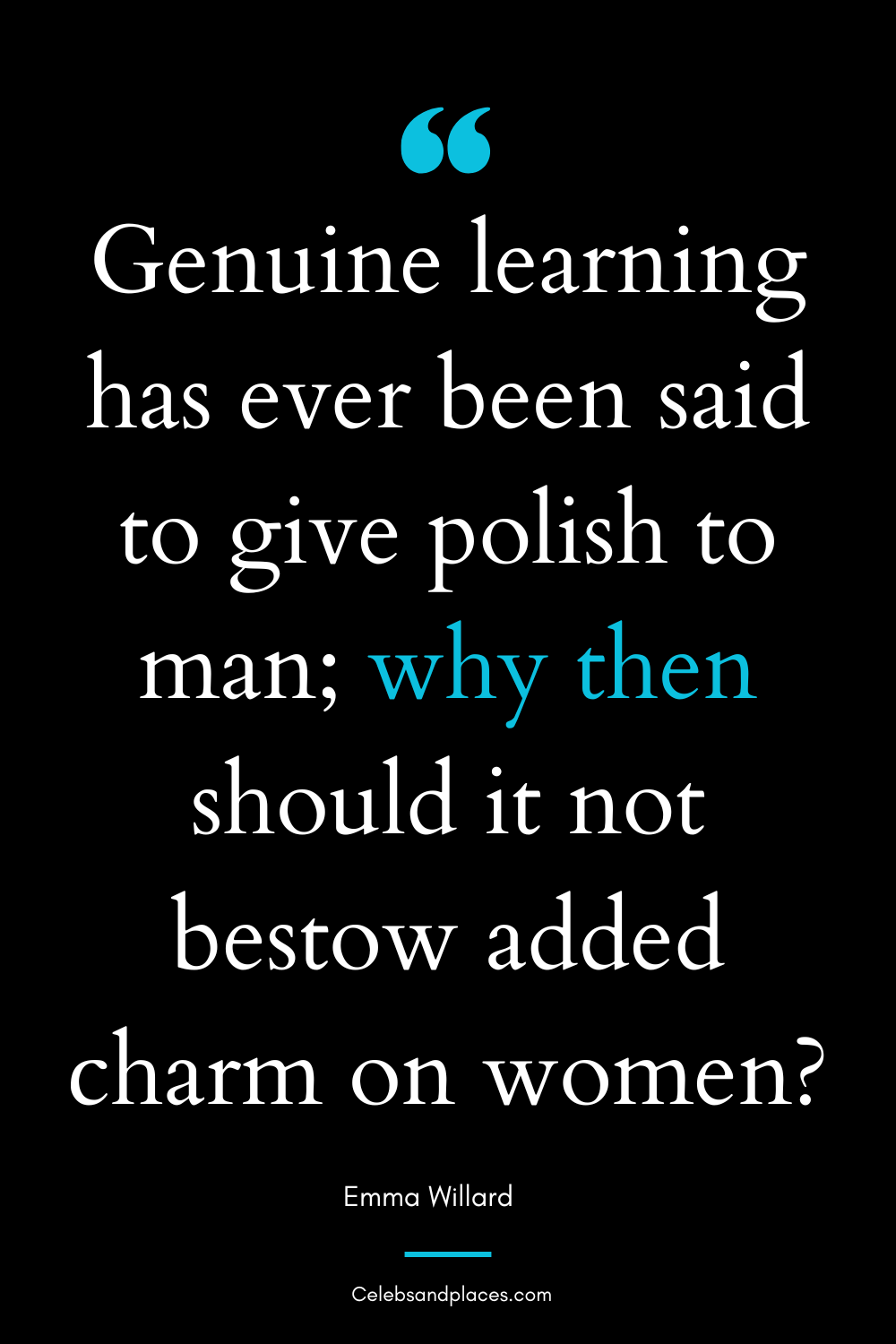
- “Genuine learning has ever been said to give polish to man; why then should it not bestow added charm on women?” – Emma Willard
Related Post: Top 25 Elizabeth Blackwell Quotes About Medicine, Purpose, and Perseverance
More Famous Quotes by Emma Willard
Emma Willard was not only a pioneer in the realm of education but also a sharp cultural critic who recognized the systemic shortcomings of her society. In many of her quotes, she exposes how women’s education had been reduced to shallow grooming for marriage rather than true intellectual or moral development. Her perspective on housewifery, teaching, parenting, and the societal role of women was deeply philosophical—she believed that every domestic and intellectual endeavor could be elevated if approached with dignity, wisdom, and purpose. Willard’s sharp assessments of educational systems and social structures called for reform not just in practice but in principle.
For Emma Willard, education was a moral force—capable of either elevating a nation or corrupting it, depending on its foundations. She viewed women as natural educators not by societal tradition alone but by divine and psychological design, with a unique sensitivity and inventiveness suited for shaping the next generation. Willard advocated for female instructors not as second-best alternatives to men but as vital agents of change whose motivations were noble and whose capacity for instruction was profound. Her thoughts on the home as the first school and on the moral obligation to build character in children reveal her deep belief that social progress begins in the family, led by well-educated and morally grounded women.
- “If housewifery could be raised to a regular art, and taught upon philosophical principles, it would become a higher and more interesting occupation…” – Emma Willard
- “The education of females has been exclusively directed to fit them for displaying to advantage the charms of youth and beauty… though well to decorate the blossom, it is far better to prepare for the harvest.” – Emma Willard
- “The world advances, it consolidates and it advances.” – Emma Willard
- “Females have been exposed to the contagion of wealth without the preservative of a good education; and they constitute that part of the body politic least endowed by nature to resist, most to communicate it. Nay, not merely have they been left without the defense of a good education, but their corruption has been accelerated by a bad one.” – Emma Willard
- “Shall he provide them male instructors? Then the graces of their persons and manners, and whatever forms the distinguishing charm of the feminine character, they cannot be expected to acquire. Shall he give them a private tutoress? She will have been educated at the boarding school, and his daughters will have the faults of its instruction second-handed.” – Emma Willard
- “In inquiring concerning the benefits of the plan proposed, I shall proceed upon the supposition that female seminaries will be patronized throughout our country.” – Emma Willard
- “By being enlightened in moral philosophy and in that which teaches the operations of the mind, females would be enabled to perceive the nature and extent of that influence which they possess over their children, and the obligation which this lays them under, to watch the formation of their characters with unceasing vigilance, to become their instructors, to devise plans for their improvement, to weed out the vices from their minds, and to implant and foster the virtues.” – Emma Willard
- “There are many females of ability to whom the business of instructing children is highly acceptable; and who would devote all their faculties to their occupation. For they would have no higher pecuniary object to engage their attention; and their reputation as instructors they would consider as important.” – Emma Willard
- “That nature designed for our sex the care of children, she has made manifest by mental as well as physical indications. She has given us, in a greater degree than men, the gentle arts of insinuation to soften their minds and fit them to receive impressions; a greater quickness of invention to vary modes of teaching to different dispositions; and more patience to make repeated efforts.” – Emma Willard
- “He is not necessarily the best teacher who performs the most labour; makes his pupils work the hardest, and bustle the most. A hundred cents of copper, though they make more clatter and fill more space, have only a tenth of the value of one gold eagle.” – Emma Willard

Final Thoughts
Emma Willard’s legacy is not confined to the founding of schools or the writing of educational treatises—it lives on in the enduring power of her words. Her quotes speak of freedom, wisdom, and vision. They are filled with hope for what education can make possible, particularly when it reaches beyond the limitations of gender or social expectation. Willard did more than imagine a better world—she laid its foundations in classrooms, in homes, and in the hearts of the women she inspired.
Today, her voice remains strikingly relevant. As we continue to grapple with questions of equality, identity, and the purpose of education, Emma Willard reminds us that true progress starts with nurturing the minds and spirits of all people. Her life and her words challenge us to think deeper, aim higher, and never stop learning.