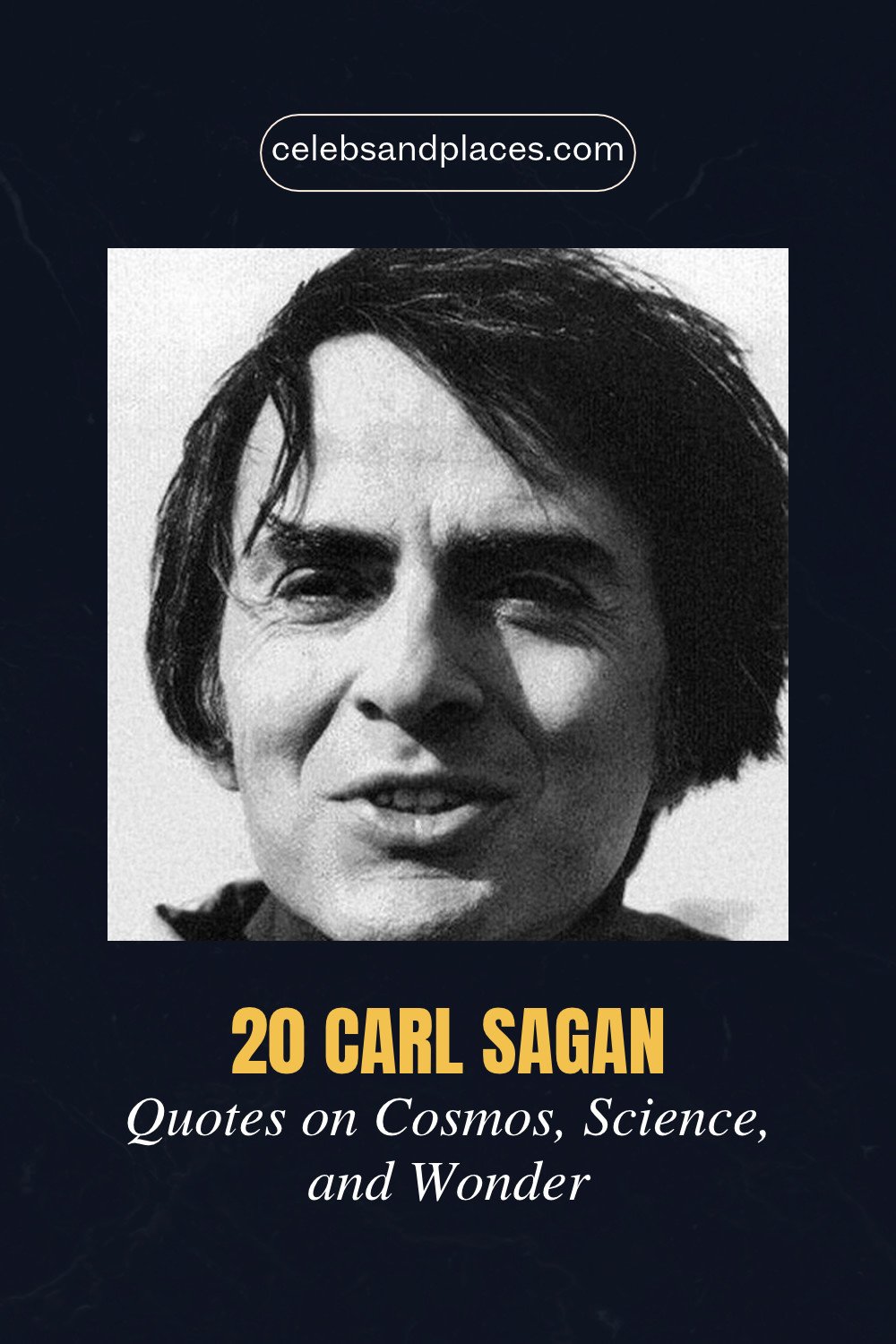
Carl Sagan wasn’t just an astronomer; he was a teacher who made the universe feel close enough to touch. He explained planets, stars, and the scientific method in language that millions of people could follow, and he never lost his sense of wonder. These Carl Sagan quotes collect his best-known lines on the cosmos, science, skepticism, and our place in the universe.
Who Was Carl Sagan?
Carl Edward Sagan was born on November 9, 1934, in Brooklyn, New York. He grew up fascinated by the night sky and by science fiction, and he earned his doctorate in astronomy and astrophysics from the University of Chicago in 1960. He later taught at Harvard and then became a professor at Cornell University, where he directed the Laboratory for Planetary Studies.
Sagan worked with NASA on missions to other planets, including Mariner, Viking, Voyager, and Galileo, and he helped design the messages carried aboard the Pioneer plaques and the Voyager Golden Records. His book The Dragons of Eden won the Pulitzer Prize in 1978, and the television series Cosmos, which he co-wrote and hosted in 1980, became one of the most widely watched science programs in history. He also wrote the novel Contact, later adapted into a film, and the book Pale Blue Dot, inspired by a Voyager photograph of Earth from billions of miles away.
Sagan died on December 20, 1996, in Seattle, at the age of 62. His influence continues through his books, the Cosmos franchise, and the generations of scientists and teachers who say he inspired them. His words are widely shared because they pair rigorous thinking with a sense of awe.
Carl Sagan Quotes on the Cosmos, Wonder, and Our Place in the Universe
Sagan often asked listeners to step back and see Earth as a small world in a very large cosmos. He believed that this view should inspire humility, curiosity, and care for one another. These quotes come from Cosmos, Pale Blue Dot, and his lectures and essays.
- “Somewhere, something incredible is waiting to be known.” – Carl Sagan
- “The cosmos is all that is or was or ever will be.” – Carl Sagan
- “Across the sea of space, the stars are other suns.” – Carl Sagan
- “We are made of star-stuff.” – Carl Sagan
- “Look again at that dot. That’s here. That’s home. That’s us.” – Carl Sagan
- “The Earth is a very small stage in a vast cosmic arena.” – Carl Sagan
- “For small creatures such as we the vastness is bearable only through love.” – Carl Sagan
- “If you wish to make an apple pie from scratch, you must first invent the universe.” – Carl Sagan
- “Imagination will often carry us to worlds that never were. But without it we go nowhere.” – Carl Sagan
- “Books break the shackles of time.” – Carl Sagan
Carl Sagan Quotes on Science, Skepticism, and Understanding
The second theme in Sagan’s writing is how to think. He defended the scientific method as a way of testing ideas honestly and warned that a society dependent on technology needs citizens who understand it. These quotes cover evidence, doubt, learning, and the joy of understanding.
- “Extraordinary claims require extraordinary evidence.” – Carl Sagan
- “Science is a way of thinking much more than it is a body of knowledge.” – Carl Sagan
- “It is far better to grasp the universe as it really is than to persist in delusion, however satisfying and reassuring.” – Carl Sagan
- “Understanding is a kind of ecstasy.” – Carl Sagan
- “Science is a candle in the dark.” – Carl Sagan
- “We live in a society exquisitely dependent on science and technology, in which hardly anyone knows anything about science and technology.” – Carl Sagan
- “Skeptical scrutiny is the means, in both science and religion, by which deep thoughts can be winnowed from deep nonsense.” – Carl Sagan
- “Not explaining science seems to me perverse.” – Carl Sagan
- “Exploration is in our nature.” – Carl Sagan
- “The beauty of a living thing is not the atoms that go into it, but the way those atoms are put together.” – Carl Sagan
Final Thoughts
Sagan’s words combine two habits that rarely appear together: a hunger for wonder and a demand for evidence. He asked readers to look up, to ask hard questions, and to be willing to change their minds when the data required it. That blend is a large part of why his work still feels fresh decades later.
For readers today, the practical lesson is to stay curious and to check claims against evidence. Read widely, learn how science works, and remember how small and precious our shared home is. Sagan’s own career suggests that explaining what we know, kindly and clearly, is one of the best ways to share the wonder.